
The stakes are clear. Massachusetts needs solar and storage.

In a new study by SEIA and Synapse Energy Economics, researchers compared a future where Massachusetts continues to add new solar and storage capacity as planned through 2030, with a future where no new projects are built after 2025.
Continuing the state’s leadership on solar and storage delivers real results: more than $313 million in annual consumer savings by 2030 and stronger winter grid reliability.
Massachusetts has been a longstanding leader on clean energy and the solar industry employs over 11,000 people across the Commonwealth. As federal policy shifts, and state leaders consider legislation to manage rising energy costs, policies that support the fundamental role of solar and storage are essential.
Real Savings, Real Reliability
If Massachusetts stays on track, by 2030, solar and storage will deliver:
- $313 million in annual savings for Massachusetts electricity customers
- $684 million in total New England savings, reducing regional price pressure
- 11% of demand served during the highest-load winter hours
- 44% of avoided energy costs occurring in winter, when reliability challenges are greatest
- 29 billion cubic feet of natural gas avoided, equal to 25% of today’s electric-sector use
- $432 – 721 million in climate and public health benefits, avoiding 1.6 million metric tons of CO₂. That’s the equivalent of taking 350,000 cars off the road for a year.
“As SEIA and Synapse’s analysis demonstrates, solar and energy storage are incredible levers that the Commonwealth can pull to deliver utility bill savings, winter reliability, and climate benefits to the state’s residents.”
– Representative Mark J. Cusack, House Chair of the Joint Committee on Telecommunications, Utilities, and Energy
Affordability
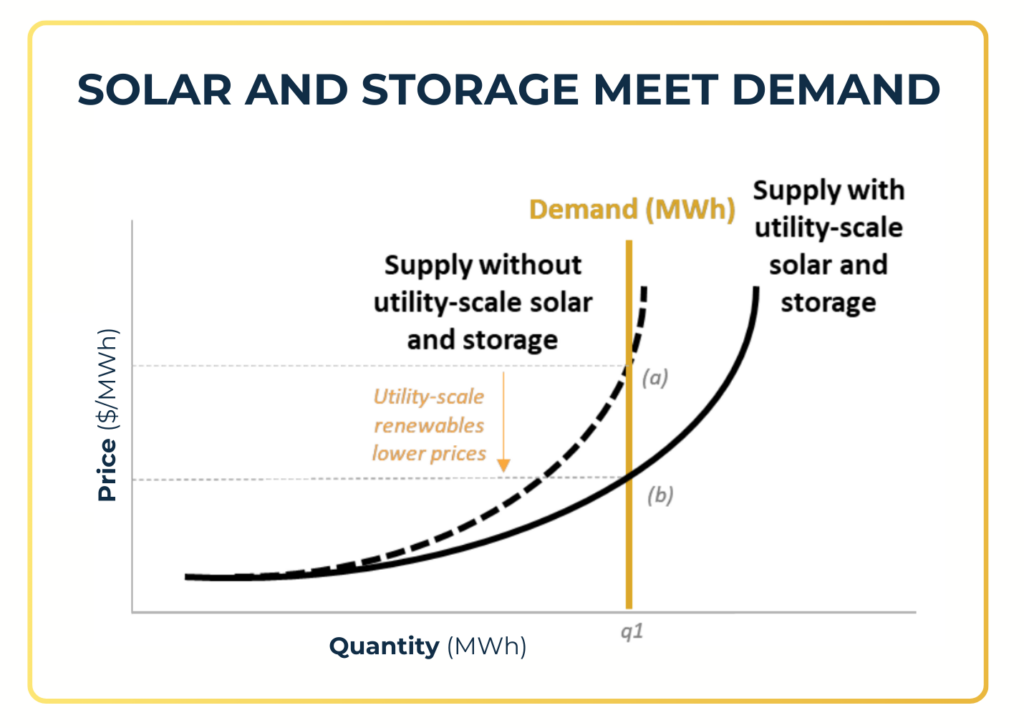
Solar and storage, the fastest and most affordable energy sources to build, lower energy costs by reducing demand on the grid and pushing down wholesale electricity prices – delivering savings when customers need relief most.
Winter Reliability
As electrification shifts peak demand to winter, solar paired with storage provides fast, cost-effective capacity that reduces reliance on gas-fired power plants vulnerable to cold-weather constraints.
Protection from Volatile Gas Prices
Natural gas is the single largest and most unpredictable driver of electricity costs. Solar and storage displace expensive fossil fuel generation and keep energy dollars in Massachusetts.
Climate Benefits
The emissions avoided by solar and storage reflect significant climate and health benefits for Massachusetts communities – with between $432-721 million in climate and public health benefits in 2030 alone.
“Adding more solar energy and energy storage in Massachusetts will also add needed reliability to our electric grid and is an opportunity to support local clean energy companies and jobs.”
– Department of Energy Resources Commissioner Elizabeth Mahony
Read the full report to see what Massachusetts gains by continuing its clean energy leadership – and what’s at stake if it doesn’t.
related content
You May Also Like